
Where high-visibility PPE is required for the work being carried out, choosing a lower-impact garment does not mean compromising on the required safety performance. Recycled and certified hi-vis is available through our range in the garment types that construction and facilities teams actually need, and some carry both EN ISO 20471 certification and Global Recycled Standard verification.
The question for most buyers is not whether sustainable hi-vis exists. It is whether it will meet the specification, survive regular washing and hold up across a full season of use. Those are the questions this article addresses.
What Makes Hi-Vis More Sustainable
The most meaningful difference in sustainable hi-vis comes down to what the garment is made from and whether that claim is independently verified.
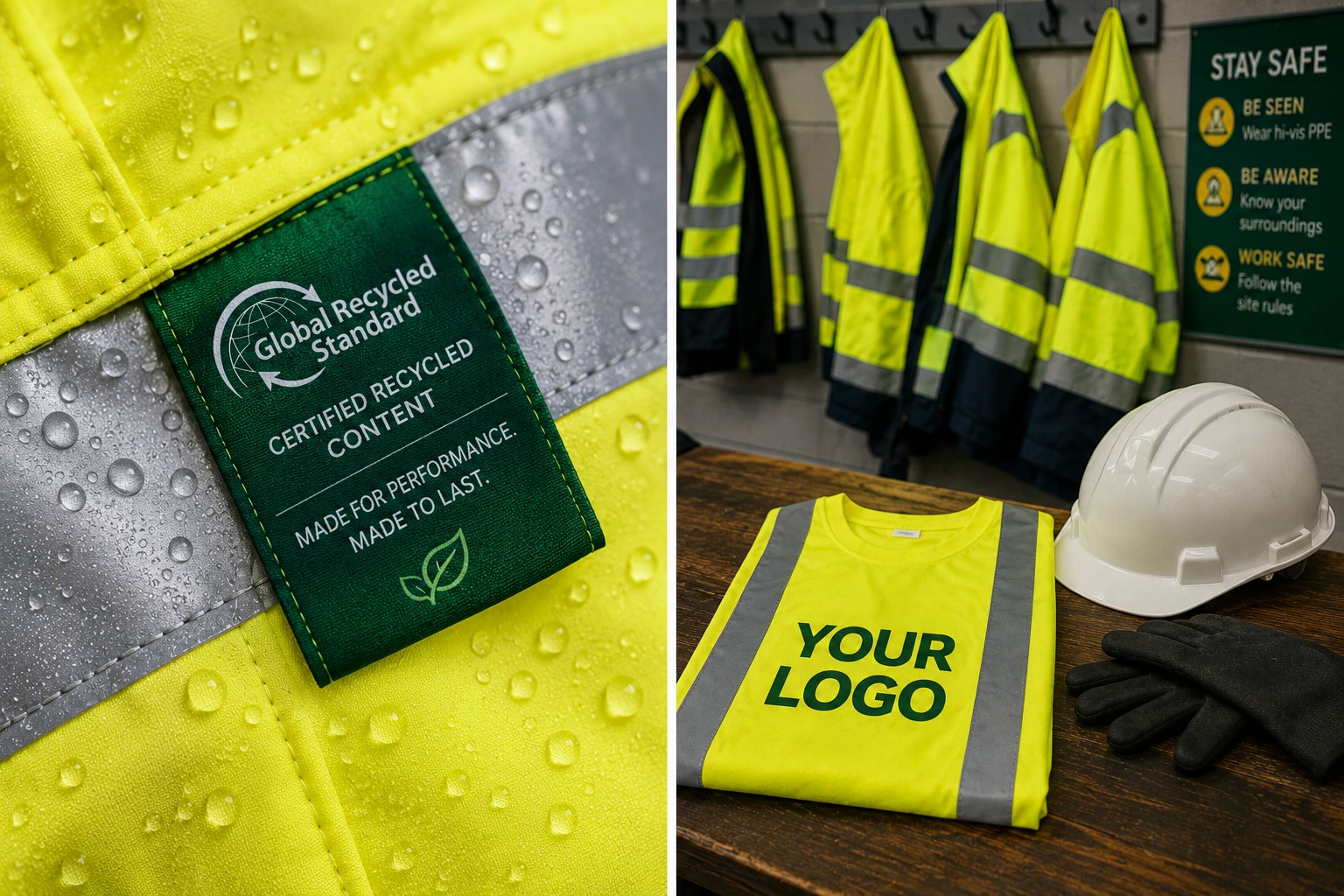
Recycled polyester is the primary material used in lower-impact hi-vis available through our range. many garments, including waterproof jackets and a unisex sweatshirt, carry Global Recycled Standard certification. GRS is an independent, third-party standard that verifies recycled content claims and traces that content through the supply chain. Where a garment carries GRS certification, the recycled content has been verified rather than simply stated on a label.
Where recycled content is independently certified, the buyer has third-party verification rather than relying solely on the manufacturer or supplier declaration. When evaluating any hi-vis product described as sustainable or recycled, check whether the garment specification includes GRS or an equivalent certification.
Durability is a sustainability consideration that buyers often overlook. A garment that performs across a full season of regular use and meets its certified wash limit before requiring replacement is a more defensible procurement choice than a cheaper garment replaced more frequently. For a team of any size, replacement frequency is a real cost that belongs in the initial purchasing calculation.
The Compliance Question
This is the objection that stops most buyers and it is worth addressing directly.
Hi-vis garments made with recycled materials can still meet EN ISO 20471 where the finished garment has been tested and certified to that standard. The certification applies to the finished garment, not to the fabric. Recycled polyester is not automatically EN ISO 20471 compliant, and a garment described as sustainable or eco-friendly is not automatically certified to any safety standard. What matters is whether the specific garment you are ordering has been tested and carries the certification for the class required.
EN ISO 20471 sets out three classes of high-visibility clothing based on minimum areas of fluorescent background material and retroreflective banding. The differences between classes relate to the coverage area required, not simply to risk in general terms. The appropriate class for any given application depends on the work being carried out and the risk assessment, not on the industry category alone. A construction worker on a low-traffic internal site and a worker on a road-adjacent project are not automatically in the same class requirement.
The Portwest eco hi-vis waterproof jacket available through our range carries EN ISO 20471 certification. When ordering any hi-vis garment, ask for the certification documentation for that specific product and confirm the class before placing the order.
Some enhanced-visibility garments may carry EN 17353 rather than EN ISO 20471. EN 17353 covers enhanced visibility clothing for situations where the full EN ISO 20471 requirement does not apply. It is a recognised standard but is not interchangeable with EN ISO 20471 where the latter is required by the risk assessment. Check which standard the application requires before specifying the garment.
Choosing the Right Garment Type
Hi-vis requirements vary between roles, environments and seasons. A single garment type across an entire team rarely serves every member of that team effectively.
Waterproof jackets are the practical choice for outdoor teams working in Irish weather conditions through autumn and winter. Several waterproof jackets are available through our range with GRS certification and EN ISO 20471 compliance, including options from Portwest and additional certified waterproof and insulated styles suited to extended outdoor use. Where a team is working in exposed conditions, a certified waterproof jacket that performs across the full season represents better value than a lower-cost garment that degrades or requires earlier replacement.
Sweatshirts and mid-layers suit environments where weather protection is not the primary requirement but visibility still needs to be maintained. A GRS-certified hi-vis sweatshirt is available through our range and is practical for facilities teams, warehouse operatives and construction workers in covered or partially sheltered environments.
Vests are a common choice where workers are already wearing sufficient base layers and the exposure and risk assessment permit a lower-coverage garment. They are practical for short-duration or task-specific use but are not a substitute for a jacket where weather protection or greater coverage is required.
Reflective shirts and safety shirts are used across facilities, logistics and lighter construction environments. They are practical for indoor or mixed use and are often specified for facilities management teams who move between environments within a single shift. Confirm the standard the garment is certified to before ordering and check that it meets the requirement for the environments the team works across.
Trousers with integrated retroreflective banding are specified where full lower-body visibility is required by the risk assessment. They are less commonly ordered but relevant for road-adjacent work and higher-exposure environments.
Wash Performance and Retroreflective Durability
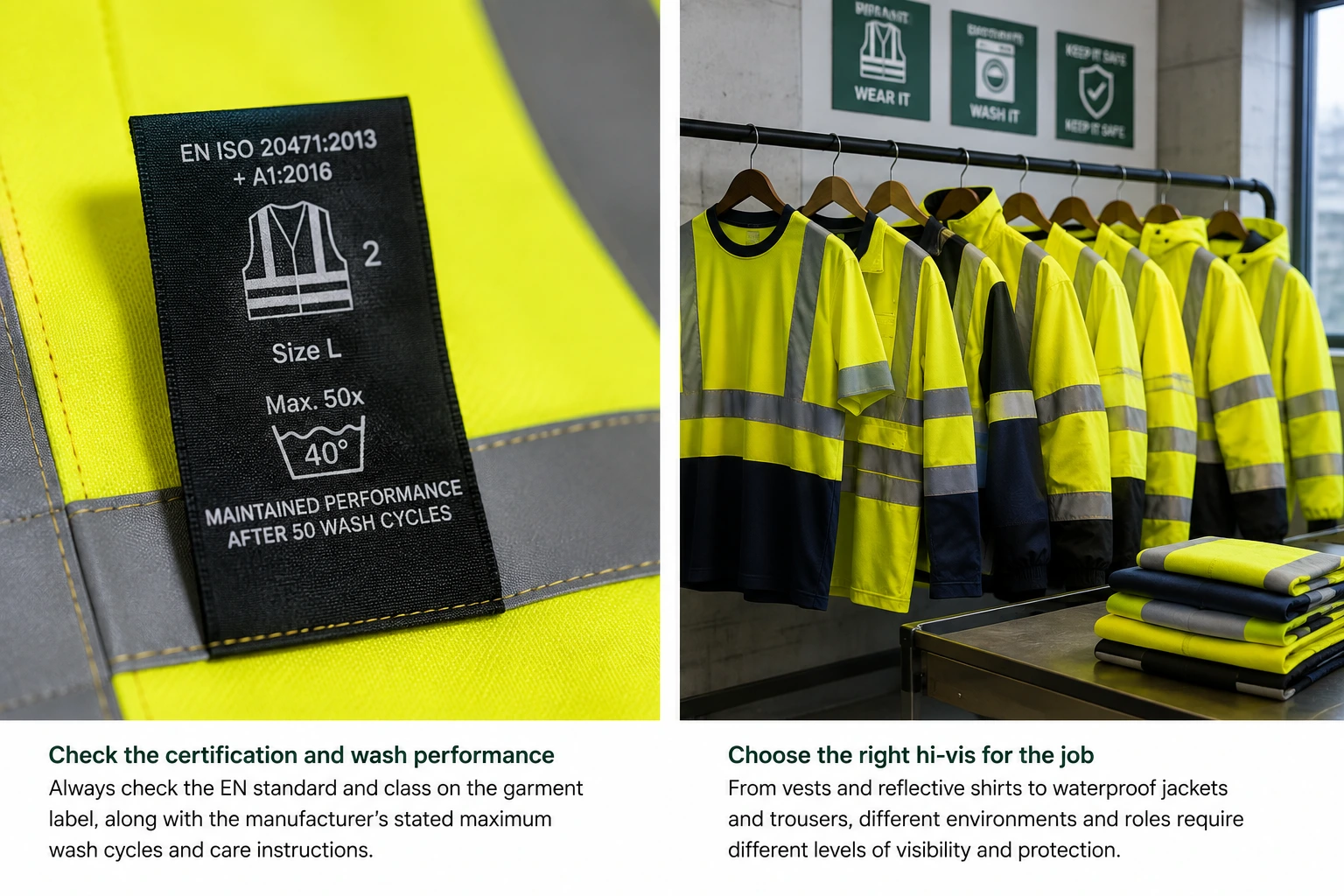
Retroreflective performance degrades with washing. The reflective strips that make a garment visible in low light and in vehicle headlights lose effectiveness over time, and washing accelerates that process. A garment that meets EN ISO 20471 on the day it is issued may not maintain that performance if washing instructions are not followed or if the garment exceeds its stated wash limit.
Some garments available through our range specify performance for up to 50 wash cycles. For teams washing garments frequently, the manufacturer's stated maximum wash cycles are a practical specification to consider alongside the garment's EN ISO 20471 class.
Washing instructions matter as much as the limit itself. Commercial laundry processes, high temperatures and certain detergents can accelerate retroreflective degradation. Check the care label and manufacturer instructions before garments enter a commercial laundry process, and confirm that the process used is compatible with the garment specification.
Where manufacturer wash data is not available on a product you are considering from another supplier, ask for it before ordering. A supplier who cannot provide that figure cannot confirm how long the garment will maintain its certified performance.
Branding Hi-Vis
Most construction and facilities operators want company logos on hi-vis. That is achievable, but placement and method require care.
EN ISO 20471 specifies minimum areas of fluorescent background material and retroreflective banding. Decoration applied to those areas risks reducing the certified performance of the garment. Logos and branding must be positioned in areas that do not compromise the fluorescent panels or reflective strips required for the garment's certification.
For non-waterproof hi-vis garments, water-based screen-print transfers and embroidery are among the branding methods we use. Waterproof garments need more careful consideration. Embroidery punctures the outer fabric and can affect waterproof performance, while any transfer method must be suitable for the garment fabric and applied within the manufacturer's decoration guidance. If you need branded waterproof hi-vis, discuss the specific garment and branding method with us before ordering.
Before any branded hi-vis order goes into production, confirm with your supplier that the decoration method and placement will not interfere with the certified fluorescent or retroreflective areas. For larger team orders, a branded sample before full production is a reasonable step. Browse the current range in our hi-vis workwear category to see the garments available for branding.
Construction and Facilities Teams: Different Purchasing Considerations
These two buyer groups share the need for certified hi-vis but their requirements differ in ways that affect which garments make sense to specify.
Construction buyers may need to consider outdoor exposure and weather protection across a full working day, interaction with vehicles or moving plant, physical wear from the work itself, layering requirements across seasons and the laundering frequency that follows from heavy daily use. Where garments are being washed frequently, the manufacturer's stated wash cycle limit is a directly relevant specification rather than a secondary consideration.
Facilities buyers may need to consider movement between indoor and outdoor environments within a single shift, different roles within one team that may carry different visibility requirements, lighter garment options for indoor-adjacent use alongside weatherproof options for external work, customer-facing appearance requirements, and consistency of supply across multiple sites or repeat orders. A facilities management contractor ordering for a large and varied team will often need a mix of garment types rather than a single specification across the board.
In both cases the appropriate visibility standard and EN ISO 20471 class depends on the actual role and risk assessment, not simply on whether the employer operates in construction or facilities. Confirm the requirement from the risk assessment before specifying the garment.
For a broader view of sustainable workwear procurement across your operation, our sustainable workwear guide covers the wider purchasing considerations.
Specifying Sustainable Hi-Vis for Your Team
The steps are practical. Confirm the EN ISO 20471 class required for the application from the risk assessment. Ask for certification documentation for the specific garment. Check the manufacturer's stated wash limit and build it into your replacement schedule. Confirm that branding placement and method will not compromise the certified areas of the garment, and for waterproof items discuss decoration options before the order goes to production.
Our range includes sustainable hi-vis options with recycled materials, independently verified recycled content and certified visibility performance, depending on the garment selected.
Browse the full selection at our hi-vis workwear category or get in touch to discuss your team's requirements.