
Merchandise is often the last item on the event plan. The venue is booked, the speakers are confirmed, the invitations have gone out, and then someone asks what is going in the delegate bags. At that point the choice is no longer about what best represents the organisation. It is about what can be branded and delivered in the time remaining.
The result is familiar. Items that recipients leave behind in the hotel room. Logos printed too small to read. A delivery that arrives the morning after the event. None of these problems are expensive to avoid, but all of them are difficult to fix once the order is placed.
This article sets out what Irish buyers should check before ordering branded merchandise for events, conferences, employee gifts and customer campaigns.
Start With the Purpose, Not the Product
Before looking at any product, decide what the merchandise is expected to achieve. The objective determines the item, the budget and the branding method, and it is much harder to work backwards from a product you have already chosen.
Common objectives include drawing visitors to an exhibition stand, giving delegates something genuinely useful during a conference, thanking employees or long-standing customers, supporting a product launch, or keeping the organisation visible long after the event has finished.
These are not the same job. A low-cost giveaway designed to attract passing traffic at a trade stand and a corporate gift intended to mark a ten-year client relationship call for entirely different products, quantities and budgets. Being clear about which one you are buying prevents the most common mistake in merchandise procurement, which is spending a moderate amount on something that does neither job well.
Choose Merchandise People Will Actually Use
The value of branded merchandise comes from how often it is used, not from how many units were distributed. A product that a recipient keeps and uses weekly carries the organisation's name for years. A novelty item that goes into a drawer carries it nowhere.
Practical categories tend to perform best. Reusable bottles and travel cups, tote bags and event bags, notebooks and stationery, clothing and accessories, and desk or technology products all have a genuine daily use. Reusable branded drinkware is particularly effective, because it is practical, easy to brand clearly, and equally suitable for conferences, workplaces and customer gifting. Insulated bottles and travel mugs also carry a higher perceived value than their unit cost suggests, which makes them useful where the budget is modest but the impression matters.
Match the Product to the Audience and Setting
The same item will not suit every audience. Think about who is receiving it, where they are when they receive it, and whether they have to carry it home.
Conferences and exhibitions suit bags, notebooks and bottles, because delegates need somewhere to put the material they collect during the day. Branded event bags do two jobs at once here, combining practical storage with visible branding that travels around the venue all day. Outdoor events favour bottles, caps and lightweight bags. Employee gifts justify better quality drinkware, clothing or gift sets, because the recipient knows roughly what was spent. Customer giveaways at volume call for practical items at a lower unit cost. Executive gifting is usually better served by fewer, better items than by more of the same.
Also consider the practical constraints. Anything heavy or bulky will be abandoned by delegates who have flights to catch. Anything fragile will not survive a busy exhibition hall.
Check Branding Options Before Choosing the Product
Product and branding need to be decided together. A product can look ideal until you discover the print area is too small for the logo, or that the chosen method cannot reproduce it properly.
Check the available print area and its shape, the number of colours in your logo, and which branding method suits the material. Screen printing, transfer, embroidery and engraving all behave differently and none of them suits every product. Check whether your logo remains legible at the size the item allows, and whether the product colour works with your brand colours or fights them.
Ask what artwork format is required and whether a visual or sample can be provided before production. A supplier who will help you adapt artwork to suit the item is worth more than one who simply accepts whatever file you send.
Ask About Lead Times, Stock and Reordering
Event dates do not move. A product that arrives late has no value; however good the price was.
Confirm current stock availability, the production time required for branding, the delivery time, and the deadline for approving artwork. Ask whether the quantity can be increased later if attendance rises, and whether the same product is likely to remain available if you want to reorder for the next event. Consistency matters if the merchandise is part of an ongoing campaign rather than a one off.
Work backwards from the event date and allow time for product selection, artwork approval, production and delivery. Building in a buffer cost nothing and removes almost all of the risk.
Compare Total Value, Not Just Unit Price
The cheapest item is rarely the lowest cost option, because cost per unit is not the same as cost per use. A practical, well-made product that is kept and used repeatedly delivers far more brand exposure than a disposable giveaway, even where the initial unit price is higher.
Consider how long the product will last, how likely the recipient is to keep it, whether the print will survive washing or daily handling, and what failure or damage rate you should expect. Then consider what the item says about your organisation. A poorly made product with your name on it does not represent neutral value. It represents a small negative one.
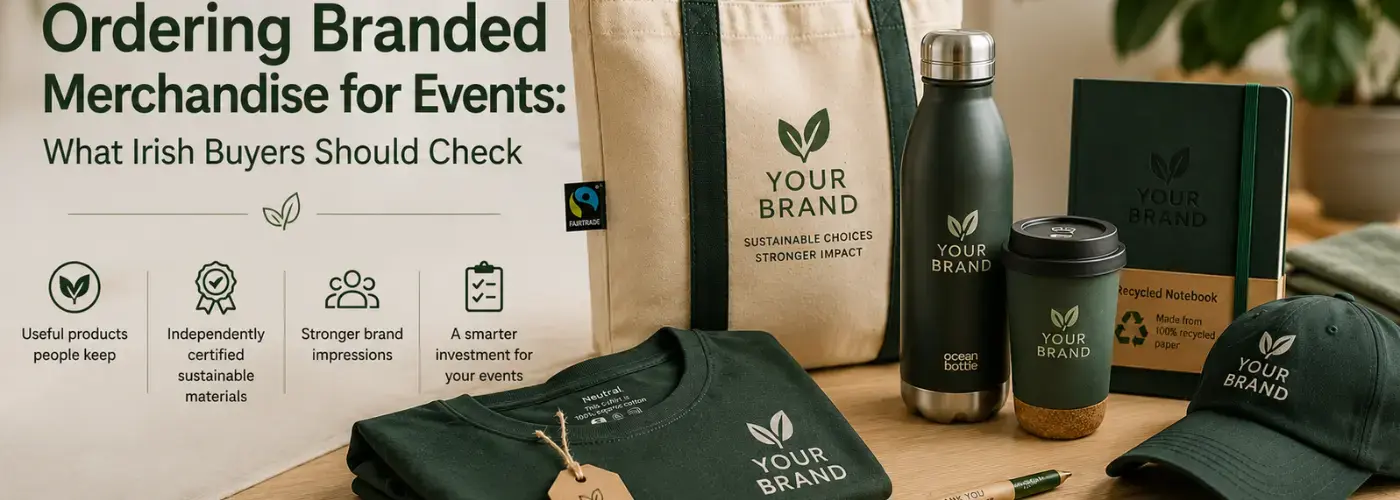
Certified materials add a second layer to that calculation. Certification does not by itself make a product last longer, and any supplier suggesting otherwise is overselling. What it does is give you something you can stand behind: documentation for procurement and sustainability reporting, alignment with commitments your organisation has already made publicly, and protection against putting your logo on an item whose environmental claims turn out to be vague or unverifiable.
The value comes from the combination. Choose merchandise people will keep, whose materials and claims can be documented, and which carries on representing the organisation long after the event has finished.
Check the Product Claims and Certification
That last point only holds if the claims stand up. Once the commercial questions are settled, check what you are actually buying.
Ask what the product is made from, and whether any recycled, organic or ethical claims are independently certified rather than simply described. Ask whether documentation is available for the specific item you are ordering, not just for the supplier's range in general. Ask where the product was manufactured. Ask whether the branding method is compatible with the sustainability claim being made about the product, since some finishes are not.
Recognised certifications to ask about include Fairtrade, the Global Organic Textile Standard, the Global Recycled Standard and OEKO-TEX. The point is not to collect certifications for their own sake. It is that you should be able to verify what you are putting your organisation's name on, particularly if the merchandise supports a wider sustainability commitment. The same principle applies when sourcing uniforms and clothing, where independently certified materials are central to choosing credible sustainable workwear in Ireland.
What to Ask a Branded Merchandise Supplier
A short list to work through before placing an order:
1. Can you recommend products suited to this audience and budget?
2. What is in stock now?
3. What are the realistic production and delivery times?
4. Which branding methods suit this item?
5. Can you provide product and certification documentation?
6. Can the item be reordered later?
7. Will I see an artwork proof before production begins?
8. What are the minimum quantities?
9. Does the quotation include branding and delivery, or are those extra?
If a supplier cannot answer these clearly, that is useful information in itself.
Getting Started
The enquiry itself is straightforward. Tell the supplier your event date, the audience and the estimated quantity. Give a budget range and your branding requirements. Review the options suggested, approve the artwork and final quotation, then allow the agreed production and delivery time.
Sustainable Workwear supplies branded merchandise in Ireland for events, conferences, employee gifts and customer campaigns, including reusable drinkware, event bags, notebooks and promotional products, all Fairtrade, organic or recycled.
👉 Contact us with your event date, quantity and budget, and we will recommend suitable options with branding costs and lead times.